The Synthetic Deluge: Why Perfectly Written Emails Are Making Us Miserable
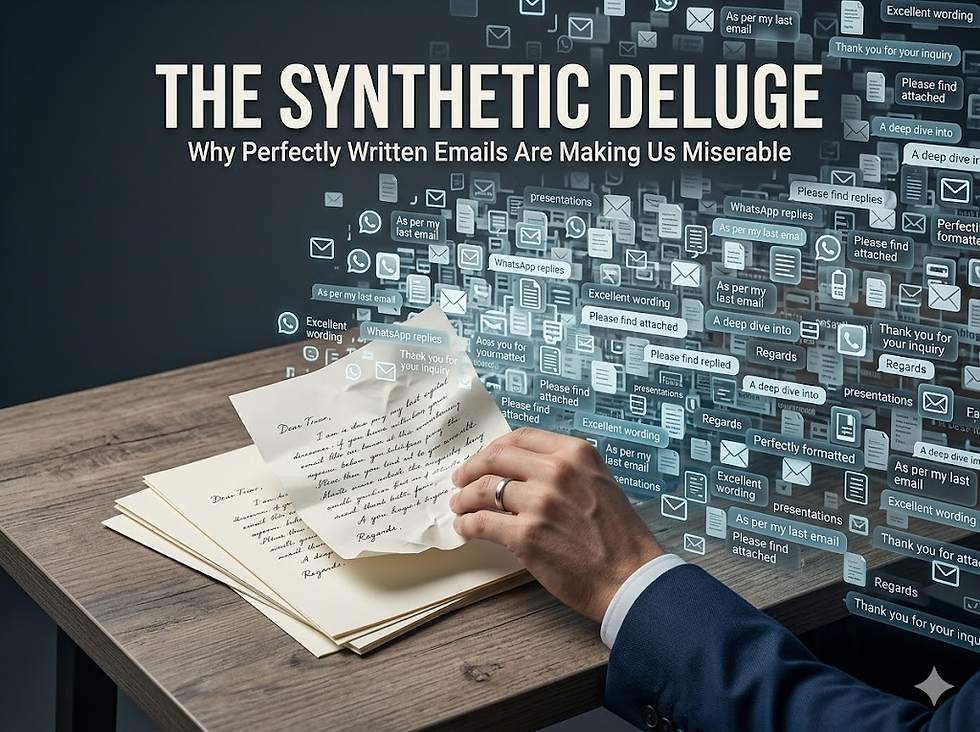
Lately, opening my inbox or checking my WhatsApp notifications feels less like catching up on work and more like drowning in a sea of pristine, immaculate... nothing.
Many of the messages I receive seems to have fantastic formatting, flawless vocabulary, and pristine English. On the surface, it looks like executive-level communication. But when I actually parse the sentences, I realize the content is entirely hollow.
It’s completely nuts. In the pre-AI days, telling a stupid or half-baked idea from a brilliant one was easy. If someone hadn't put thought into a concept, it usually looked like it—the email was rushed, disorganized, or blunt. Your brain’s natural filter could spot the lack of effort instantly and deprioritize it. Today, the filter is jammed. Now, because low-effort ideas are wrapped in the slick, authoritative skin of a corporate consultant, I find myself having to read more attentively just to realize there is no substance underneath. It is creating a massive, invisible overhead just to process everyday information.
I only recently read that cultural critics, tech essayists, and workplace researchers are beginning to give this phenomenon a name—and their perspectives explain exactly why our brains are feeling so fried.
1. The Rise of "Workslop" and Critical-Thinking Camouflage
The internet has spent the last couple of years laughing at or lamenting "slop"—the low-value, AI-generated junk imagery and bizarre articles filling up search engine results. But as generative tools have been deeply integrated into enterprise platforms, the crisis has migrated into our daily work lives. Commentators now call it "Workslop."
"workslop" is defined as the noisy, low-quality, AI-generated output that looks helpful on the surface but actually shifts the burden of editing, verification, and critical thinking entirely onto the recipient.
In a traditional workflow, the friction of writing acts as a natural logic check. When you sit down to draft an email or a presentation, the actual act of writing forces you to debug your own thoughts. You realize halfway through a paragraph that your argument doesn't hold water, and you fix it. But when people dump a vague, half-formed thought into a prompt box and hit "generate," they outsource that cognitive friction. The AI dutifully outputs a statistically probable, beautifully organized response that the sender pastes without ever truly assimilating it.
The result? We are being forced to read, analyze, and reply to arguments that *nobody actually formulated in their own head first.*
2. The Asymmetric Attention Tax
This shift breaks a fundamental social contract of human communication: the unspoken rule of mutual effort.
Historically, effective communication relied on an asymmetry that benefited the reader. A thoughtful colleague would spend twenty minutes distilling a messy, complex project status down into three razor-sharp bullet points. They invested their cognitive energy to save yours.
Generative AI flips this contract entirely upside down. Now, the sender spends two seconds typing a lazy prompt ("Write a long, polite email explaining why the project is delayed"), and the AI instantly subsidizes the writer with 500 words of generic prose. But it still takes you, the human recipient, several minutes of active reading to cut through the polite, algorithmic fluff and find the actual facts.
As software analysts tracking workplace productivity paradoxes have noted, this creates an Asymmetric Attention Tax. AI hasn’t reduced the workload of communication; it has simply moved the bottleneck downstream. It allows the sender to externalize the mental cost of writing, turning their lack of effort into your reading overhead.
The Silver Lining: Evolving Our Algorithmic "Bullshit Detectors"
Make no mistake: I’m not anti-AI content. Whether it’s a quick reply, a full article, or multimedia, AI has its place. What I’m against is the lazy, thoughtless automation of human communication. Hell, I even ran this draft through AI to clean up the phrasing—but every core idea is completely my own.
Despite how frustrating this synthetic deluge is, something fascinating is happening: human beings are rapidly adapting.
We are beginning to develop highly sensitive, instinctual AI bullshit detectors (I started my own evolution 1yr ago). Because "flawless, polished, and polite" has become the frictionless, zero-cost default baseline of the internet, it has completely lost its premium value. It no longer signals authority; it signals a lack of care.
Our brains are learning to intuitively spot the telltale signs of synthetic prose—the predictable pacing, the emotional sterility, the weirdly hollow enthusiasm, and the over-reliance on transitional phrases.
And this is where the true power of human communication reasserts itself. AI cannot create richness from a hollow core.
The New Luxury Good: Human Friction
As the synthetic deluge grows, the pendulum is inevitably going to swing back. We are entering an era where authentic, thoughtful, and deeply human communication will become the ultimate competitive advantage.
When the world is flooded with sterile perfection, we begin to crave the "sweat of the brow"—the clear evidence that a human being sat down, wrestled with a problem, and cared enough about our time to write something real.


Comments